Run your front office through the draft
Run your team’s 2027 draft: decide when to spend capital moving up, collect later picks or make the selection. GM mode starts with three rounds selected; set your team and CPU strategy before entering the room.
A trade changes where you pick and who remains available. Compare package values, then use the tracker to follow your new selections. For a quick first-round session, open the main mock draft simulator.
How to play the NFL GM simulator
- Open your front office. Start the game above. Three rounds are preselected; change to one or two if you prefer a shorter draft.
- Choose the CPU strategy. Board + team needs gives nearby players a bounded preference based on dated source priorities. Best available follows source rank alone.
- Choose your team. Select a team to see how many picks it holds, then use View to inspect its capital. That count includes choices acquired through trades in the source snapshot.
- Decide whether to trade first. Start draft advances to your next selection. Trade first pauses the CPU before pick one so you can attempt to acquire an earlier pick.
- Build the class. Search the board by player or school, use a position filter, and select a player. The tracker records every choice and the current pick holder.
- Review the result. Undo action reopens your last manual decision. Save draft retains the session for the same browser. Share draft creates a public, read-only link to your completed picks and trade log. You can also copy or export the results.
A team without a selection in the chosen rounds is marked No picks; you can inspect it, but cannot start until you change rounds or teams. Control all teams enters commissioner mode, giving you every selection yourself; single-team trade negotiations are unavailable because you already control the whole draft.
Trade down, trade up: how trades work in this GM simulator
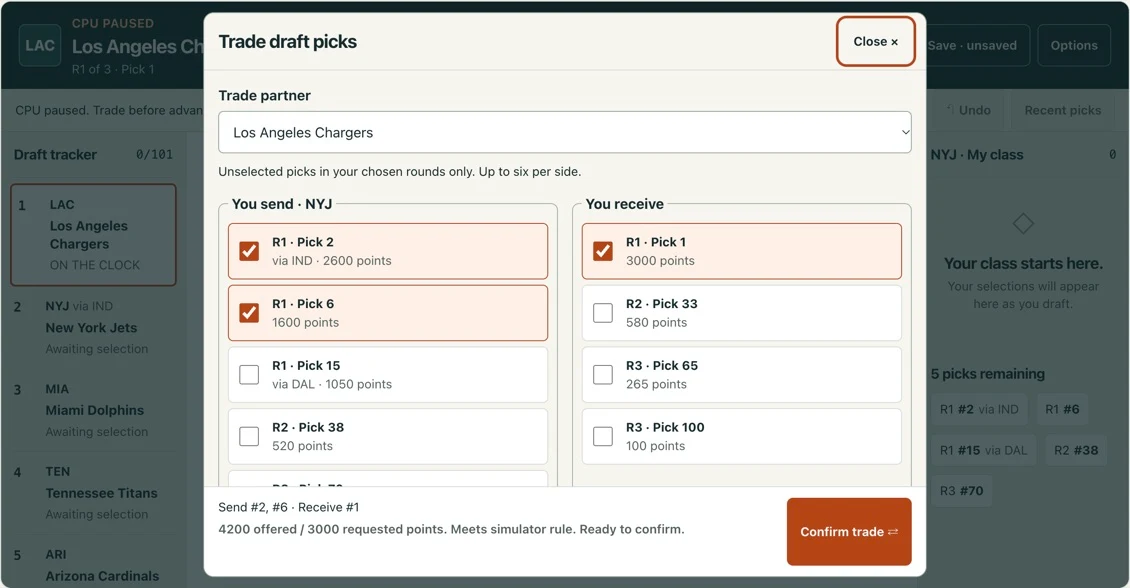
Use Trade first if you want to move ahead of your team's first selection. The CPU pauses at the beginning of the draft, and the trade window lists the unselected picks owned by each partner. Choose what you send and what you receive. Both sides must include at least one pick, with no more than six per side. Choices from rounds outside your session are excluded. With all three rounds selected, this snapshot offers up to 31 potential trade partners.
The window displays public chart points for both packages. The CPU accepts an offer worth at least 95% of the points it sends away. This threshold is a transparent game rule, rather than an estimate of what a real general manager would accept. A rejected package leaves your pick ownership unchanged. You can add another choice, reduce your request, or close the window and keep drafting.
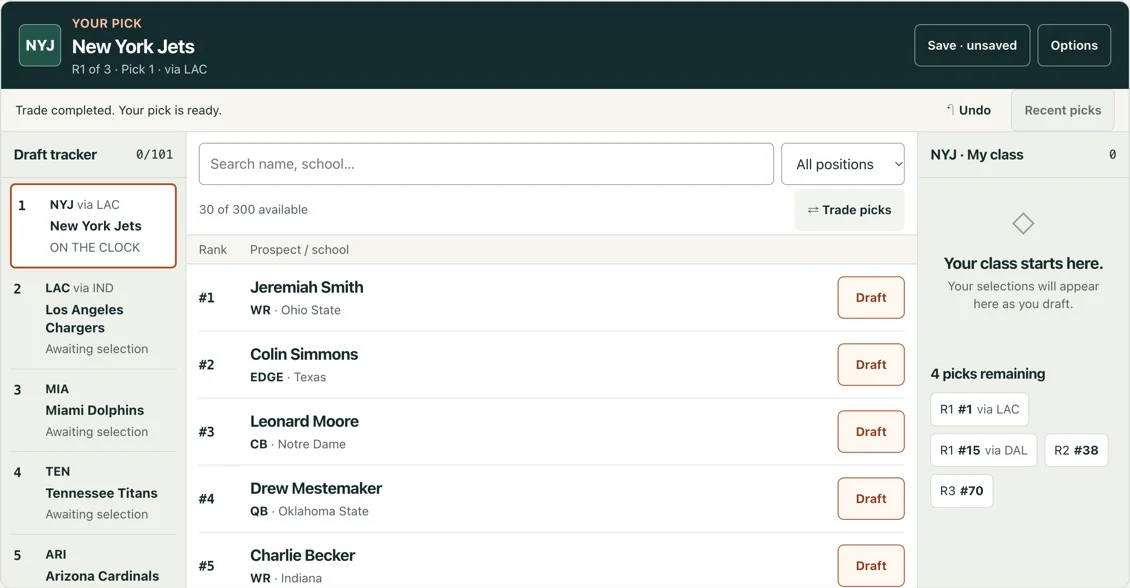
Once a trade completes, the tracker assigns those selections to their new holders. If it is not your turn, Simulate to my pick advances the CPU using your chosen strategy. A target pick that has already been made cannot be acquired retroactively. The model supports no player-for-pick transactions and no future-year capital; it works only with picks in the rounds you select.
Trade down and compare the combination
At your selection, Trade picks can exchange the slot for later choices. Compare the remaining players and package values before confirming. The CPU stays paused after a trade so you can inspect your new capital.
Consider the whole class: an early lineman can leave a different group available later than an early receiver. Undo revisits your latest manual selection or trade and removes the CPU choices that followed.
The need-aware CPU lowers its preference for a position group after drafting that group. It still respects a limited range around the best remaining source rank. This creates a repeatable way to explore different classes, without claiming to know private scouting grades or the real intentions of a team. Read our simulation method for the exact comparison formula and trade rules.
Research the order and the players
Use the first-round order to check pick ownership and the prospect board to research players by name, school or position.
GM mode uses the same board and order snapshot as the mock draft simulator. It is a dated projection, not a live roster, standings or injury feed.
Save a scenario you can explain
The result shows your team's class and a complete draft tracker. Share draft creates a link that anyone can open to view the full board and simulated trades without an account. Shared results are a separate snapshot, so later data updates do not change those picks. Exported text records simulated transactions as well as selections, so another fan can follow how you acquired the players. There is no letter grade or projected win total: the point is to compare scenarios and explain your reasoning. A highly ranked prospect is not guaranteed to succeed, and the chart's points do not establish a real market price.
Saving uses the anonymous player associated with this browser. Clearing cookies, moving to another device or changing the dataset may prevent a saved session from loading. Export a text copy if you want to keep the result separately. Comments are public; use them to discuss your choices without posting personal information. For source mismatches or private questions, see contact and corrections.
What this GM simulator covers, and what it leaves out
Draft-room play includes 300 ranked prospects, pick ownership from the source snapshot, trades using a 95% chart-value threshold, one to three rounds, saves, result links and text exports. Use the trade controls to compare packages and build your class.
The model leaves out salary caps, free agency, contracts, seven-round drafts and letter grades. Read the GM questions before starting if you want season management or an online multiplayer room.
NFL GM simulator: questions players ask
What is an NFL GM simulator?
Here, you run your team's draft: manage its picks, compare trade packages and choose a class from the prospect board. GM mode opens with three rounds selected; the main mock draft entrance defaults to the first round. Both use the same draft engine.
Can I trade in this GM simulator?
Yes, in single-team GM mode. The CPU accepts an offer worth at least 95% of the public chart value it sends away. You can negotiate with any other team that still holds an unselected pick in your chosen rounds; commissioner mode does not include trade negotiations.
What is commissioner mode and why can't I trade in it?
Commissioner mode lets one person make every team's selection. Single-team trade negotiations are disabled because you already control all sides of the draft. Choose one team if you want to negotiate pick trades with the CPU.
Does GM mode simulate the salary cap and contracts?
No. This mode covers draft selections and trades of unselected 2027 picks. It does not simulate contracts, a salary cap, free agency, player-for-pick trades or future-year draft capital.
How many rounds does a GM mode draft run?
GM mode starts with three rounds selected. You can change to one or two before starting. Three rounds contain 101 projected picks, including five projected compensatory slots. This version has no seven-round mode: its verified order covers the first three rounds, and we do not invent the later selections.
Do I get a draft grade at the end?
No. The result shows your team’s selections, the full draft tracker and trade log. Share draft creates a public result link; you can also copy or export it. Source rank and pick-chart points are references, not an official scouting grade or projected win total.
Can I run a multi-team draft with friends?
You can take turns on the same device using commissioner mode, with one person making each selection. There are no separate player seats, shared online rooms or live multiplayer. After finishing, use Share draft to send a read-only link with the full board and trades.
Is the GM simulator free?
Yes. The GM simulator is free to play online in your browser, with no account or download required.
Talk draft.
Who did you take, and who did you pass on? Share your draft strategy.
Start the conversation with your draft picks.